Why Kobe Beef Is Popular in Japan
Become 2lbs of FREE Mishima Reserve Wagyu! Merits this offering
Why is "Kobe Beefiness" and then famous?
By Joe Heitzeberg - Co-founder and CEO of Crowd Cow. I'g on Instagram at @jheitzeb.
Share:
And what are you missing out on if it'southward the only brand of Japanese beef y'all know?
The term "Kobe Beefiness" is one of the most famous — virtually mythical -- terms in the world of food. Information technology'due south also ane of the most misunderstood and misused.
Bachelor now: Japanese A5 Wagyu
Oversupply Cow works straight with some of the best Wagyu farms in Nihon.
Shop Now Limited time just.
Outside of Nihon, the phrase "Kobe Beef" has go near synonymous with "Japanese beefiness" or "Wagyu", merely it'south not that simple. Permit's break it down.
Wagyu = "Japanese beefiness"
Wagyu is just a word that means "Japanese Beefiness". There are four breeds of Wagyu cattle that are native to Japan. Of these breeds, in that location is one that stands out as something truly remarkable: the Kuroge Washu.
It's a breed with a unique genetic predisposition to marblizing its fatty inside the muscle tissue. That incredibly marbled beef has become synonymous with "Kobe beefiness" and A5 Wagyu. Information technology's because of this special breed, the Kuroge Washu.
The ecosystem necessary to produce A5 Wagyu -- the gene pool, methods of raising the animals, the feed regimen, the organizations and expertise needed to charge per unit and certify the beef correctly -- is completely unique to Japan.
Simply put: The highest form of Wagyu gets a rating of A5. Some of it ends up being called Kobe, if information technology'south from a particular part of Japan.
A5 Rank Kobe Beefiness in Nippon
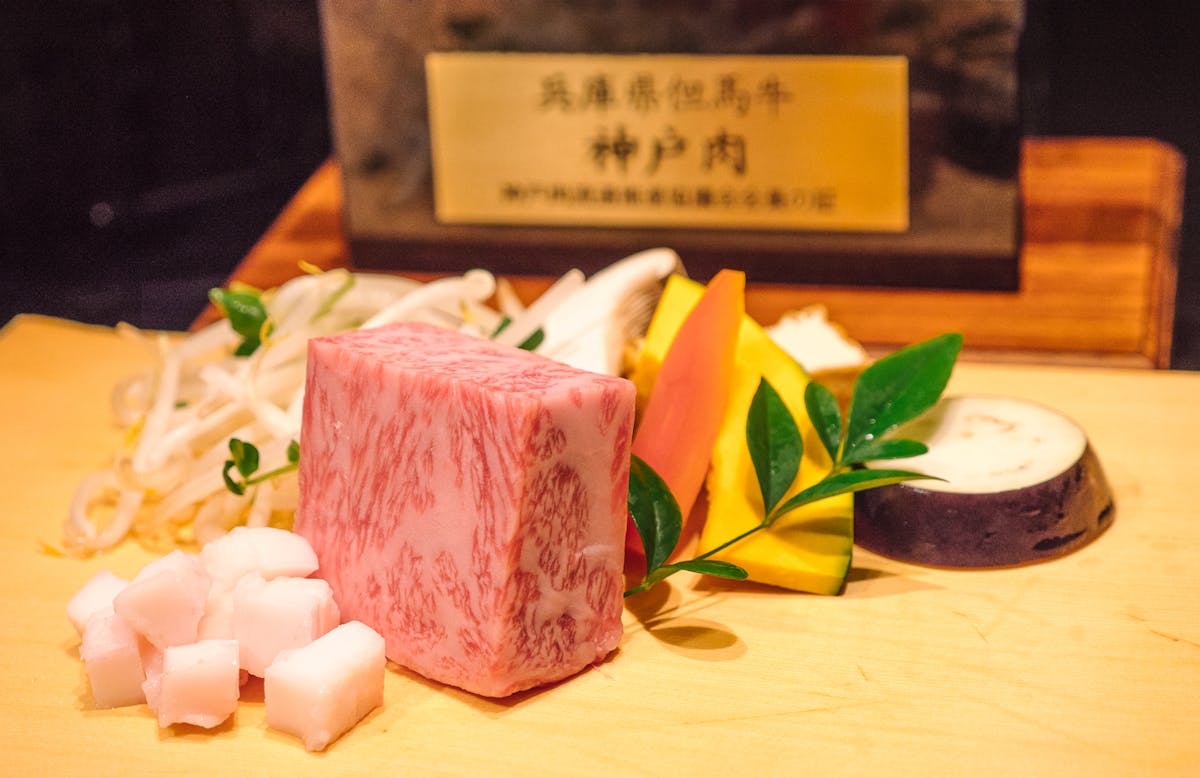
What exactly is Kobe Beefiness?
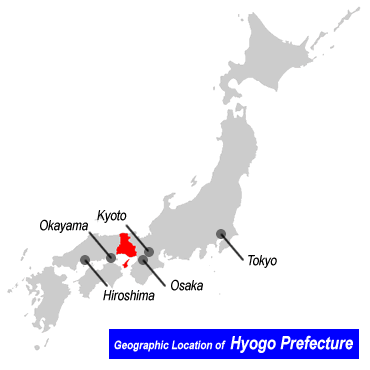
We've been to Japan several times to consult producers in Hyogo prefecture who enhance Kobe Beef cattle, and have met with chefs in Kobe and Osaka who serve it. Nosotros've besides spoken direct to the Kobe Beef Marketing Clan in Kobe to understand what qualifies something every bit "Kobe Beef."
Check out our Japanese Wagyu Infographic
The start matter to understand is that "Kobe Beef" is a brand name maintained by the Kobe Beef Marketing & Distribution Promotion Association based in Kobe and formed to protect the integrity of the Kobe Beef brand name.
It's kind of like how you can't phone call any former cheese Parmeggiano-Reggiano -- cheese from Italy merely gets that name if it'due south from the right region. Information technology's a matter of Italian law.
The Kobe membership consists of producers, slaughterhouses, distributors, retailers and restaurants who pay the association membership fees in club to use the "Kobe Beef" proper name.
For beef to qualify every bit Kobe Beefiness, the following criteria must be met:
- the producer and slaughterhouse must be paying members of the Kobe Beef Marketing & Distribution Promotion Association
- the steer must exist Tajima cattle (a term that effectively means Kuroge Washu-bred cattle raised in Hyogo prefecture)
- the steer must be born in Hyogo prefecture
- the steer must be raised and fed in Hyogo prefecture
- the steer must be processed at slaughterhouses in Kobe, Nishinomiya, Sanda, Kakogawa, or Himeji in Hyōgo Prefecture
- the BMS level must be 6 or higher on Japan'southward 12-point scale
- the meat quality score must be a iv or 5 (out of 5)
- the gross weight of beef from the fauna must be 470 kg or less
A simple mode to sympathize Kobe Beef is that information technology is a brand name for A4 and A5 beefiness that comes from Hyogo prefecture in Japan. In addition, beef from Hyogo prefecture that happens to achieve an A4 or A5 rating will but be called "Kobe Beefiness" if it comes from producers and processors that have paid to be role of their marketing association.
The weight requirement is also unique. Because the animals that authorize are on the smaller end, some say this has an affect on taste, others say it has no consequence. One thing it definitely affects is toll — smaller animals tend to be less profitable and therefore prices have to be higher to brand up for costs like processing.
Award-winning Kobe Beef at Steak Sakura in Osaka
Membership has its privileges...and costs
It'southward possible for a single producer with a unmarried herd of animals to enhance some animals that authorize as Kobe Beef and others which do not from the same herd. This is a function of where the animals are harvested and how they are rated. For example, an fauna that rates equally A4 or A5 simply which is sent to a processor that isn't part of the Kobe Beef Marketing Association tin can't earn the Kobe Beef marking.
As a applied matter, only the Kuroge Washu breed is capable of achieving an A4 or A5 rating — because of the intense marbling that merely this breed can accomplish — and at that place are many regions and brands of beef in Japan besides Kobe Beef that can achieve that level of quality.
Membership into the program is a rather non-footling annual fee. The international brand recognition and the costs of membership are reflected in the priced paid by customers, of up to 2X the price of A5 Kuroge Washu from other brands.
A Cursory History of Kobe Beef
Although cattle were raised in Japan for thousands of years, they were draught animals for a long time. Vegetarianism wasn't put on official pause until until the Meiji era, which began in 1868, when Nihon opened up to the residual of the world and foreigners passing through the biggest cities demanded meat. Their own eating habits still, Japanese producers began raising animals -- meat animals -- to encounter the demand of strange diners. Vegetarianism was ended and producers raised beef animals for the Japanese market, equally well.
Here'south where the Kobe part comes in...
Yokohama was 1 of those emerging centers of trade between Japan and the rest of the globe during the Meiji era, and it was full of foreigners who wanted to swallow beefiness. Cattle and horses were both popular work animals in Nippon, merely cattle were raised in the southern parts of Japan and horses were used upwards north almost Yokohama.
Thus, when foreigners working in Nihon asked for beef, cattle needed to sourced from the s and shipped northward from Kobe. When these foreigners tried this Japanese Kuroge Washu beefiness from the south and noticed the natural marbling and succulent umami taste, they were impressed. Since the beef was being shipped via the port of Kobe, that name get associated with this unique beef, fifty-fifty though the beef in fact came from all over the south of Nippon, and just made a final pitstop in Kobe.
And so for a while, Japanese Wagyu and alive animals were imported to the United states of america from Japan until both were banned from existence exported. In 2012 small quantities of beef from Nihon resumed export, later on the U.S. lifted its own ban on imports.
Beware: Fake Wagyu abounds!
Real Wagyu actually imported from Japan is quite rare in the U.s.. The export of cattle and cattle Dna from Japan was banned many years ago, and remains banned. The export of beef resumed only recently (in 2012).
For perspective, every bit of November 2017, at that place are only 21 restaurants in the Us which serve real Kobe Beef from Nippon. It's served at the Wynn in Las Vegas where a one pound of it will fix you back $880.
Endless restaurants and groceries use the terms "American Kobe," "Kobe" or "Wagyu" to misguide consumers and to capitalize on the reputation of Kobe Beef and Japanese beef in general. Our advice if you see "American Kobe" on a bill of fare or a label? Run!
There are in fact breeders in the United states who raise Kuroge Washu cattle, ranging in purity from 100% "full blood" and on downwardly to undocumented, unregulated cantankerous-breeds of unknown purity (Wagyu-Angus cross, or "Wangus"). The USDA's Agricultural Marketing Service provides certification services to beef producers including Wagyu and Wagyu crossbreds. Our advice if y'all see anything in the USA with "Wagyu" written on it is to ask the folks behind the counter if it's certified? What % Kuroge Washu is information technology? Make sure your purchase premium is justified.
Producers in Japan may be biased when they say there's a huge difference between Kuroge Washu that's been bred, raised, inspected and rated A5 in Japan versus anything you might find in the USA, including 100% (by DNA) fullblood Wagyu that was raised in the Usa or Commonwealth of australia. They say it'due south because the gene pool of Kuroge Washu in the USA is quite narrow to begin with since Nippon banned all DNA exports years ago, and only a minor quantity always got out of the land in the starting time identify -- and considering they've continued to improve the genetics in Nippon through selective breeding practices.
Japanese producers and connoisseurs volition tell you that zilch bred overseas can match the marbling, umami or overall quality of an A5 Wagyu from Japan. It's intuitive that the Japanese would have mastered the arts and crafts of producing A5 Wagyu as a high art over many decades, and that such expertise, experience and community does not exist outside of Japan.
I've seen (and tasted) some incredibly marbled 100% (by Deoxyribonucleic acid) Fullblood Wagyu bred and raised in the U.s.a., and I've sense of taste-tested adjacent with A5 Wagyu from Japan. Like wine, there are differences at that place are differences and individual tastes will vary. Try them both. Try them both and exist your ain judge!
Also, regarding Angus-Wagyu cross (where the percentage of Wagyu is less than 100%, usually far less and frequently unregulated) tin can also be amazing beef. In fact, for the American palate and way of grilling and consuming large portions, information technology may even be the preference for nigh people. A5 is a different matter entirely: so richly marbled, decadent (and expensive) that yous just couldn't eat a huge steak all at once. When done right, Angus-Wagyu cross is like the great steakhouse Angus you are familiar with, but with even amend marbling — more than even than Prime, whereas A5 is an experience every bit much every bit a repast, to be savored in small bites and on special occasions.
Kobe Beef FAQ
Q: Do Kobe beef cows get massages?
A: Nope. Although all Wagyu ranchers in Nippon use slightly different practices, and certainly there may be somewhere that "massage" is expert, most probable this is just a mistranslation or misunderstanding stemming from the practice of brushing Kuroge Washu to remove dirt in gild to reduce stress.
Q: Are Kobe and Wagyu beef the same?
A: No. Wagyu just ways "Japanese moo-cow". In that location are vi breeds of Wagyu and four of them are native. Of these, the Kuroge Washu is unique in its ability to produce richly marbled beefiness, the best of which is rated A5. Kobe Beefiness is just a make name of Kuroge Washu which comes from Hyogo Prefecture (near Kobe).
Q: Is Kobe beefiness in the US real?
A: The majority of the fourth dimension when you see the discussion "Kobe" on a carte du jour or in a store, it'due south probably not Kobe Beefiness (the brand of beef from Japan) nor is it even Kuroge Washu (the premium breed of Wagyu from Nippon) or A5 Wagyu (the highest rated Kuroge Washu beef from Nihon). Less than a dozen restaurants have Kobe Beef, and only a scattering of outlets behave actual A5 Wagyu from Nihon.
Q: What are the 8 restaurants that sell Kobe beefiness?
A: Actually in that location are now 21 restaurants that serve Kobe Beefiness (the real thing).
These are: The Wynn in Las Vegas, 212 Steakhouse in NYC, Alexander'due south Steakhouse in Cupertino and San Francisco, Shibumi in Los Angeles, Armory in San Francisco, Bazaar Mar in Miami, Bazaar Meat in Las Vegas, MGM in Las Vegas, Nick&Sam's Steakhouse in Houston, RPM Steak in Chicago, B+B Butchers + Eating place in Texas, Jean Georges Beverly Hills, Gibsons Italia in Chicago, Castle Hotel & Spa in NYC, OMAKASE in San Francisco,
MINIBAR by José Andrés in Washington DC, and Roka Akor in Chicago and Houston. Continue in mind this doesn't mean it will e'er be on the menu.
Q: What is "American-style Kobe beef," or "American Kobe?"
A: Frankly, the term doesn't mean much. If you see "American Kobe" on the menu or on the label, our advice is to run. At best it's a slick marketing trick to endeavor to get you lot to pay a lot more for something that'southward not worth the money. If you want real Kobe Beef, caput to one of the restaurants above or look for "A5 Wagyu" and brand sure it'southward coming from Japan.
In our view, the use of the term "Kobe" and smattering of Japanese characters on crossbred Angus beefiness from the U.s.a. is misleading.
When done correct, Angus-Wagyu cross is like the bang-up steakhouse Angus you lot are familiar with, but with even better marbling — more even than Prime. That's very dissimilar from the decadent, umami-packed experience of A5 Wagyu, which is rich and best savored in small quantities.
Q: Is Kobe Beef in the U.Southward. fake?
A: Most of the time, aye. When yous consider the sheer number of times "Kobe" appears on some mystery beef that is certainly not actually Kobe Beef... Aye. Run across above for a definition of Kobe Beefiness and for a list of the 21 restaurants that actually do carry authentic Kobe Beef from time to time.
Q: Is all Kobe Beef grass-fed?
A: Nigh all beef in Japan consumes grass (roughage such as hay, rice harbinger, or silage) for at least some of their lives, merely are grain-finished (on cereals such as corn and soybeans). The corporeality of time on roughage vs. grain mixes varies by farm and way of beef. For example, Olive Wagyu from Shodoshima is finished on a inawara rice straw and toasted olive peels for 2 months before harvesting.
Q: Why is Kobe Beef and then marbled?
A: There are many factors that contribute to the intense marbling that Kobe beef and A5 Wagyu are known for. First is the breed of cattle used -- Kuroge Washu -- which has a unique genetic predisposition to marblizing its fat inside the muscle tissue. Second is the environment -- Japanese ranchers raise Wagyu cattle with the intent of minimizing stress as much as possible. Less stress ways more fat and more tender meat. Lastly, they are fed a loftier-calorie diet consisting of roughage and grains so the animals gain weight.
Emerging Beef Brands in Nihon
In Nihon, there are over 300 brands of beefiness in addition to Kobe Beef, including other then-called luxury beef brands such equally Matsusaka, Ohmi and Saga beef.
In addition, a "craft beef" miracle is currently taking root in Japan with the emergence of artisanal beef varietals such equally Shinshu Apple Beefiness, Olive-fed Beefiness from Shodoshima, Osaka Umechan Beef, Hokkaido Snow Beef and many more.
All of these center on the Kuroge Washu breed and generally qualify only if they accomplish an A4 or A5 rating -- much higher beef quality and marbling than American Angus beefiness is capable of achieving under any atmospheric condition.

Wagyumafia A5 Kobe Beef Chateaubriand
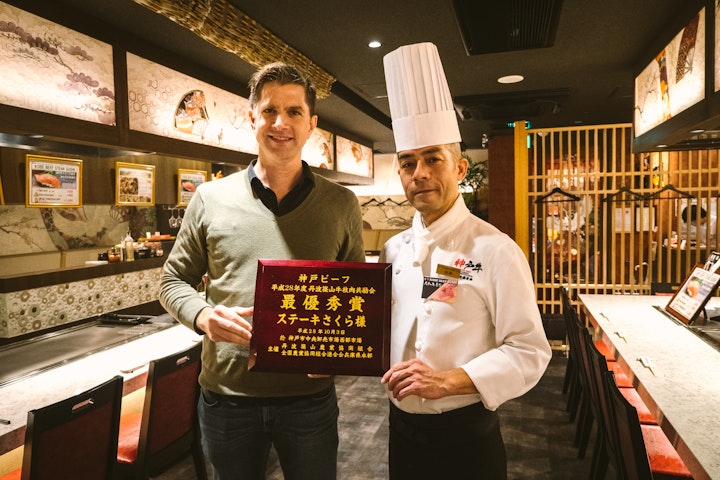
Steak Sakura in Osaka (Kobe Beef)
Bachelor at present: Japanese A5 Wagyu
Crowd Cow works directly with some of the best Wagyu farms in Nihon.
Store Now Limited time only.
Shop:
Tags:
You lot may also similar
Source: https://www.crowdcow.com/blog/why-is-kobe-beef-so-famous

Postar um comentário for "Why Kobe Beef Is Popular in Japan"