whats a good gauge to run for power wire in your boat
Cull The Correct Wire Size
Information technology'southward of import to utilise the right sized electric cabling for any project aboard. Using the wrong ane could create a plethora of issues.
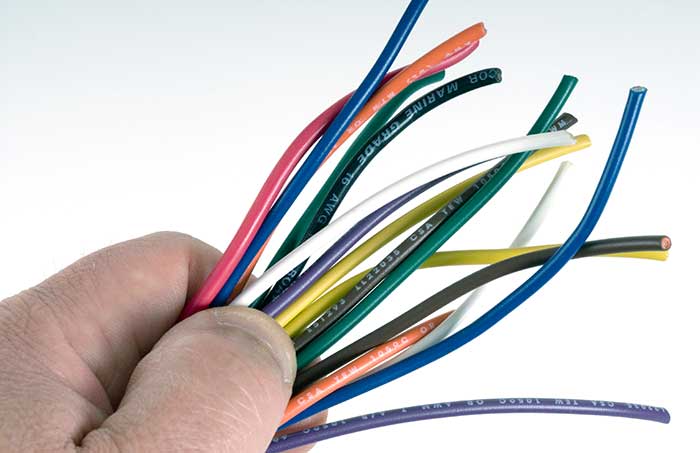
Photo: Mark Corke
One of the common questions DIY boaters inquire is what size wire they need when performing an electric accessory installation. This is a good question to ask for safety besides every bit for operation reasons. Electrical equipment simply cannot deliver its all-time performance if it's not getting enough power, and wiring also small for the task is one surefire way to ruin an otherwise neat and orderly installation and limit the adequacy of the equipment. From the prophylactic side, wire too modest for the job creates excessive electrical resistance. The primary side effect of excessive electrical resistance is oestrus, and enough rut can start a fire.
Tip
Plough off all ability before starting any work on the boat'due south wiring.
With these thoughts in mind, let'due south walk through the steps to selecting the correct size wiring for that new electric gizmo y'all absolutely must have.
Is It AC Or DC?
The start matter you'll need to identify is whether the electric circuit in question is running from DC bombardment power, a solar panel or wind generator, or supplied by AC shore ability, a generator, or DC-to-AC inverter. The criteria for determining wire guess size is completely dissimilar depending on these ability sources.
With direct electric current (DC) circuits, one of the primary concerns is what we refer to every bit "voltage driblet." Because nosotros typically are dealing with either 12 or 24 volts — comparatively low values — we're concerned about any voltage loss due to electric resistance. With shore power and the like, we're typically dealing with either 120- or 240-volts AC — much higher values — and so a lilliputian loss has a less dramatic impact on equipment performance. That said, because we are dealing with higher voltages and often college amperage demands from the AC equipment in question, electrical resistance caused by loose, faulty connections and wiring that is besides small for the chore can generate pregnant, dangerous heat more than quickly than a similar fault with a DC excursion.
Sizing for Air-conditioning circuits
Because AC excursion wire sizing is a bit simpler than DC, nosotros'll start there. Again, with Air-conditioning, our primary business organisation is rut buildup as cables go routed through your boat. Sizing of private conductors is based on three things: (i) how much amperage the circuit is going to have running through it, (2) whether the cable is routed through a hot engine room space, and (3) the temperature rating for the cable insulation. An additional concern is when multiple cables are bundled together, which increases the potential for fifty-fifty more than heat.
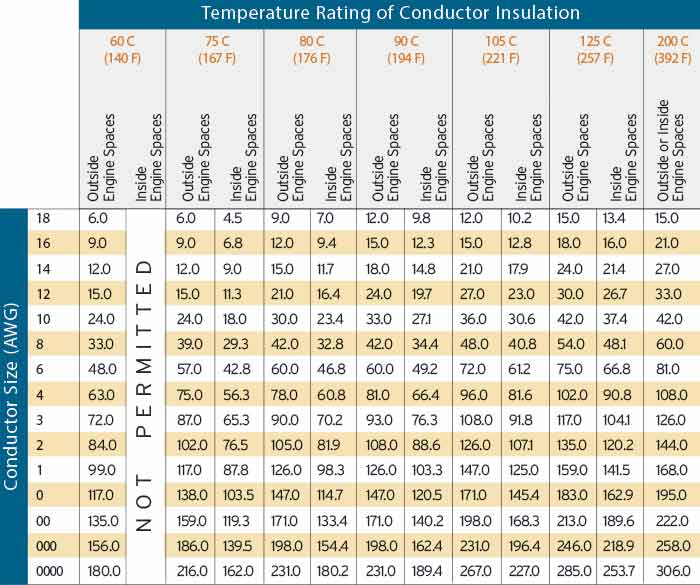
Cables are rated for their insulation temperature rating – how much heat they tin can tolerate. This rating is specially important for Air-conditioning cable routed through engine room spaces. (Chart from ABYC Electrical Certification Study Guide)
Ac wiring is primarily what we call "triplex" and sometimes "iv-usher" cable. The green grounding conductor is not counted when considering bundle size. You only need to count normal electric current-carrying conductors. So a single piece of triplex cable has two current carrying conductors: the hot wire and the neutral, or the black and white wires. In the case of 240-volt four-conductor cablevision, in that location are going to be three current-carrying wires per cable: two hot wires and a neutral. Again, the greenish grounding wire does not get counted. (Annotation: If you're dealing with a foreign-built boat, colour coding and conductor count may exist a bit different than described hither.)
Another of import outcome has to do with Ac cables routed through engine room spaces because of the potential for more than rut. This heat may require "derating" to a larger wire size. I often get questioned this mode: "The cable run is 14 feet long, and all but 8 inches of it is routed outside the engine room. Practise I need to derate as if information technology were all routed through the engine room?" To comply with standards, the answer here is "yes." You lot must e'er rate based on the weakest link in a circuit. Cables are also rated for their insulation temperature rating, or how much heat they can tolerate. Most boat cable today is rated at least 105 C, and this temperature rating should be establish on the outer jacket insulation on the cable.
Wiring that is too minor for the chore can generate pregnant, unsafe rut.
At that place are ii means to find the correct AC wire size: The first is to consult the American Boat & Yacht Council (ABYC) AC wire sizing charts found inside ABYC Standard E-11. Boaters can access ABYC standard E-11 past going to the ABYC website. Navigate to the recreational boater area, and click on the "become a member" link. Sign up for the free trial membership, and use that five-day window to proceeds admission to the E-11 standard. In East-11, y'all'll find a serial of tables to aid you properly size Ac conductors using the criteria outlined here.
A second, much easier alternative is to download the ABYC Wire Sizer app ($iv.99) for iOS or Android smartphones. The app does a not bad job of getting y'all to the standard compliant wire size for both Ac and DC installations and, unlike other apps bachelor, will also convert to metric wire sizing for those of you lot with European-congenital boats. Continue in listen that the search does not realize that the minimum wire gauge size the U.Southward. Coast Guard will allow is sixteen AWG (American wire estimate), with some exception for the employ of 18 AWG under certain standards-specified circumstances. This applies to both AC and DC circuitry.
Sizing For DC Circuits
Equally already mentioned, we're peculiarly concerned about voltage drop with DC circuits, so office of the circuit design criteria is determining how long the circuit is. Past that, I hateful the altitude from the power source to the load or appliance, and dorsum to the source of power. Remember, all wire has inherent electric resistance, and the longer the run of wire and the smaller the wire, the more resistance will be present. Likewise remember that the inherent resistance is less for heavier wire versus sparse wire.
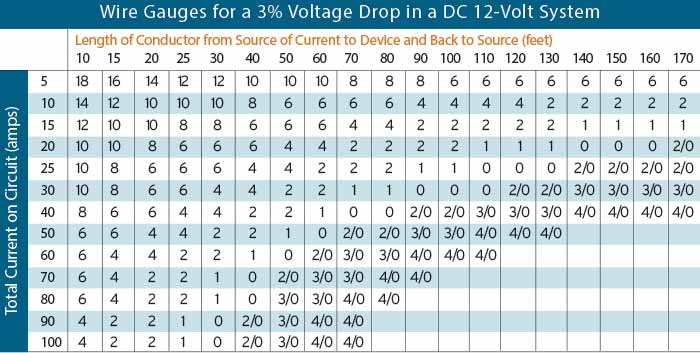
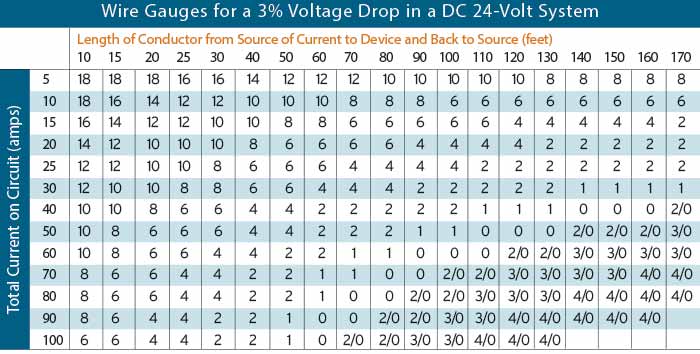
Voltage driblet due to electrical resistance in low-voltage systems can have a dramatic impact on equipment functioning. (Charts from ABYC Electrical Certification Study Guide)
System voltage and amperage brand a divergence, too. With higher voltages, smaller gauge wire tin be used to conduct higher amounts of amperage. This creates a compelling reason to use higher voltages, only that'due south a story for some other day.
The other issue that needs consideration when sizing DC conductors is what level of voltage drop is going to be acceptable for the excursion in question. This is an area that the Coast Baby-sit addresses in its regulations for recreational boats. ABYC mirrors the regulations in its E-11 Standard. The choices here are iii% and ten%. Consider that a 10% voltage drib means that with a fully charged battery, rather than 12.6 volts, but 11.3 volts will be present at the device. Will it operate correctly at that voltage? If not, you'll need a larger wire.
The 3% maximum voltage drib level is reserved for what the Coast Guard and ABYC believe are "mission critical" circuits. These circuits are identified as battery-to-distribution panel principal conductors, navigation lights, critical electronics for communication and navigation, and bilge blower circuits.
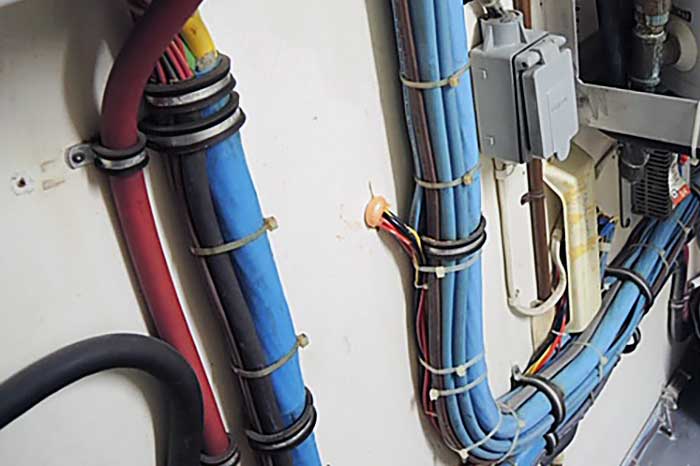
Bundling cables together increases the potential for generating estrus.
Many people ask why bilge pump circuits are not on this iii% listing. It'southward of import to understand that the Coast Guard does not fifty-fifty crave bilge pumps, and in the eyes of ABYC, bilge pumps are intended for removing incidental accumulation of water in the bilge from rain, washdown, and the dripping stuffing box on a propeller shaft. A bilge pump will not salvage you if you lot put a half-dozen-inch pigsty in your gunkhole below the waterline! All other circuit wiring tin be wired to a 10% maximum voltage driblet level.
So to summarize, when sizing DC conductors, you need to know:
- operating voltage
- current draw in amps
- adequate level of voltage drop
- length of the excursion
Once all this information is nerveless, it'due south dorsum to one of several tables plant in the ABYC E-xi standard or the wire sizer app. Plug in the data and get your wire approximate size. Several important notes on that: (1) Remember the smallest wire approximate size immune by ABYC and Coast Baby-sit is xvi AWG with some exceptions for 18 AWG, and (2) using the app is more precise than using the ABYC tables. With the tables there is a mathematical rounding effect, and the user should always round upwards in size, pregnant that you will ofttimes stop up using larger diameter wire than you lot really need to get the job washed safely.
Writer
Ed Sherman
Correspondent, BoatUS Magazine
Ed Sherman is the writer of The Twelve Volt Bible for Boats, The Power Boater's Guide to Electrical Systems and Advanced Marine Electrics and Electronics Trouble Shooting. He currently serves as vice president and education managing director for the American Boat & Yacht Quango.
BoatUS Magazine Is A Do good Of BoatUS Membership
Membership Benefits Include:
-
Subscription to the print version of BoatUS Magazine
-
four% back on purchases from West Marine stores or online at WestMarine.com
-
Discounts on fuel, transient slips, repairs and more at over i,200 businesses
-
Deals on cruises, charters, automobile rentals, hotel stays and more…
-
All for only $25/twelvemonth!
Source: https://www.boatus.com/expert-advice/expert-advice-archive/2020/february/choose-the-correct-wire-size
Postar um comentário for "whats a good gauge to run for power wire in your boat"